Thinking Like a Designer
Hint: it's not all sticky notes and rainbow crayons. It's even more fun!

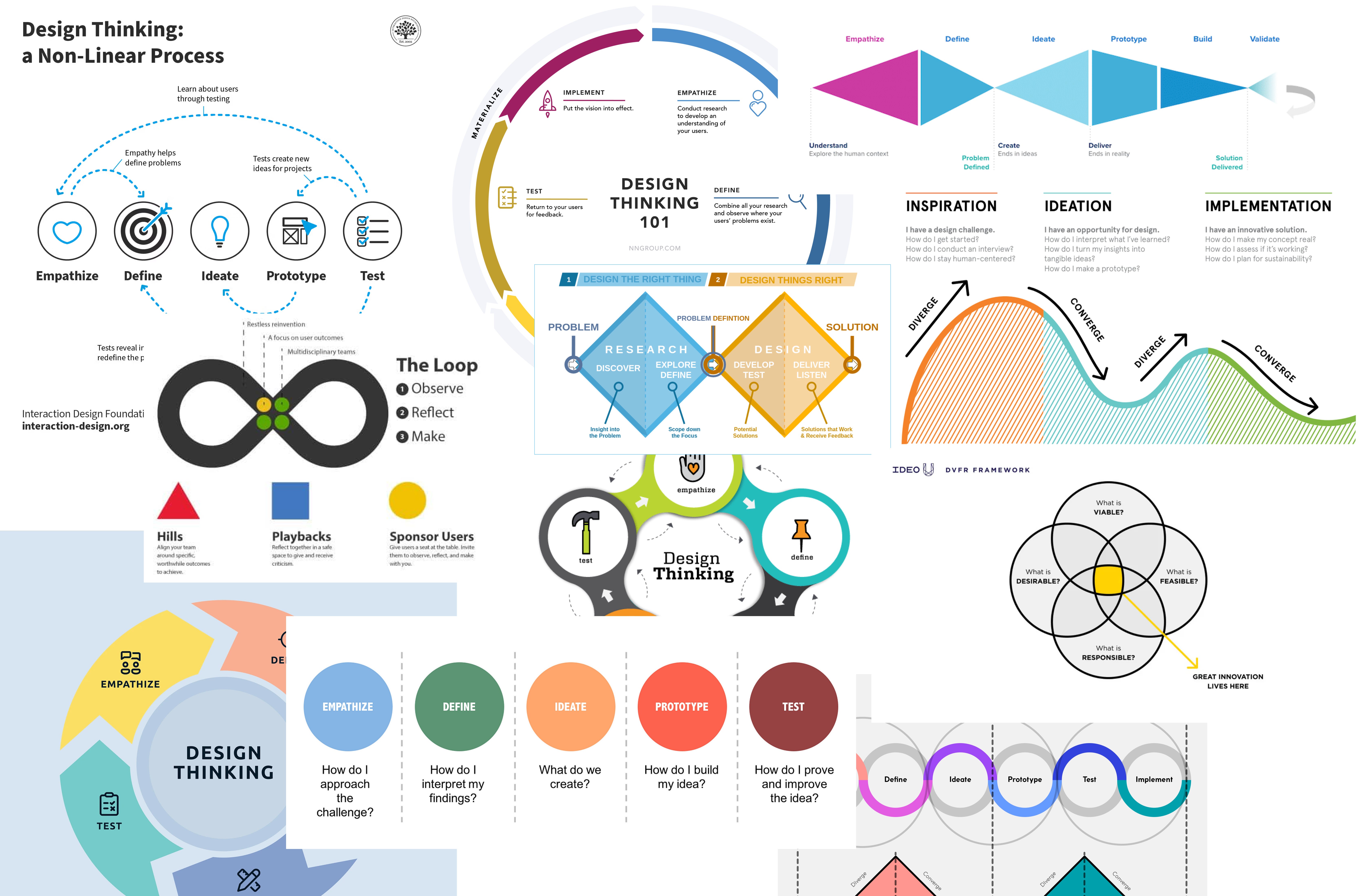
These days, it feels like every organization has some form of a design thinking process chart in the shape of some sort of flowy circle, curvy loop, or a tilted square. But what does it mean exactly to think like a designer? And how do we start doing it in practice?
It’s fun. It’s all about exploration and planning!
Well, here’s our take on it. For one, design isn’t an exact science. We can follow the general scientific method, forming hypotheses and using them for our tests, making observations as we go, rinse and repeat. In a lot of ways, designing is very similar. However, the scientific method is much more rigorous, and the goal is often to try to narrow things down to one or two variables to explain a phenomenon. It’s a lot more precise and exacting, while design is more of an additive approach where you try many different explorations to satisfy needs and constraints. It’s important to note that design thinking is really a framework of thinking that involves constant iteration. Design doesn’t always take the form of a deliverable; design can be a workflow that is created or an approach to organizing your team. There is always an improvement to be made to a design, always endless ways to innovate. The only real limitations are the usual - time, money, and a deadline.
Design is everywhere.
It doesn’t really matter what infinity loop or fancy spiral design thinking is presented as, there are a few key points about design itself that will help you begin thinking like a designer even if you’re unfamiliar with the discipline.
Design is all about exploration. Keeping an open mind and fresh eyes about the way you approach things. Ever think about how children seem to be able to come up with so many imaginative ideas? Ever think back to when you were a child and would roleplay as dragons and knights and come up with ridiculous scenarios that you never quite revisited as an adult? Design is all about keeping that childlike wonder of the world, starting by exploring things that aren’t necessarily bound by real life constraints. By removing constraints and keeping your eyes wide open at the beginning of the process, only then can you have access to the variety of ideas that can form something truly innovative. And once you have all your beautiful, fresh ideas, then you can start adding real world constraints to them so that you can select ideas that can actually be executed.
It’s challenging. You are in charge of recognizing the constraints and the limitations of your design.
Some common examples of constraints might be simple limiting factors of having a small budget or a small team with an incompatible skillsets. These can usually be foreseen at the start of the project, though sometimes you may find constraints that were invisible at first. These hidden constraints can be things like an unforeseen compliance requirement or a need for highly specialized equipment. However, to even get to understanding these little details, you have to explore the big picture first and then hone in.
Seasoned designers may seem to understand what these hidden requirements are from the get-go which makes it seem like they don’t do much exploration. In truth, it’s because they’ve experienced so many of these types of users, situations, and requirements that they have become better equipped to handling them. Even seasoned designers have to take a step back and re-evaluate their ideas. Design thinking as a process is a lot like how painters often have to take a step back from their large canvases to reevaluate their values and overall cohesion and then make changes from there. It’s easy to get lost in the weeds of the nitty gritty details, so it’s important to constantly reassess if the design works as a whole.
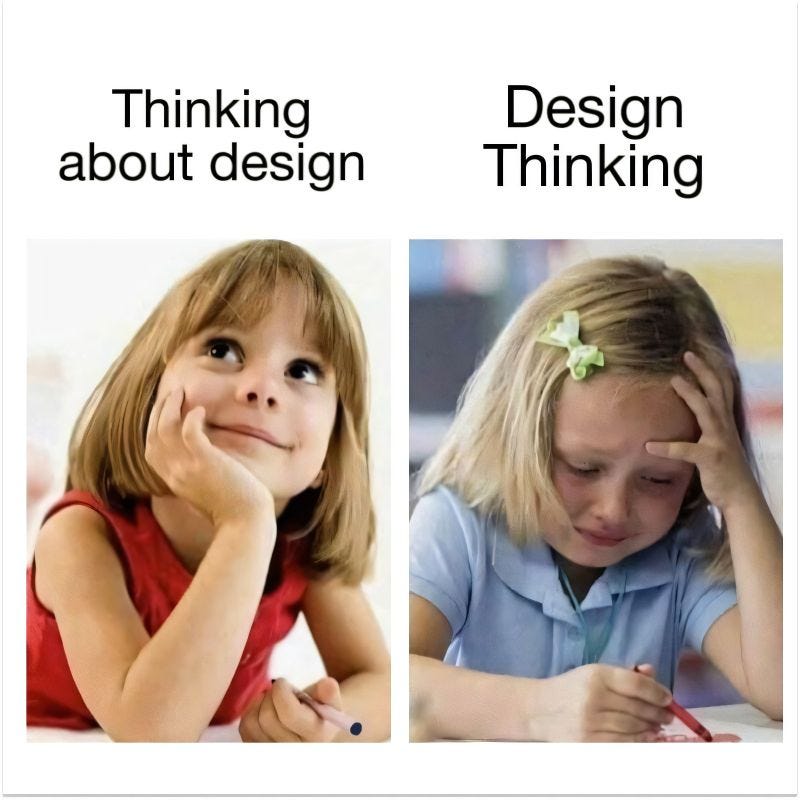
It takes a lot of practice. Even good designers have to hit the design gym often!
Some good ways to start building your design muscles is simply by giving yourself projects with some basic constraints. Maybe a visual design project like “design a postage stamp for the next Olympic game.” At first, this seems simple enough. You start with doing research on the country that the games will be in, doodling ideas for cool imagery for your stamp. But then as you look into it, you may realize that your country’s mail courier has certain postage regulations in regards to size, that stamps have a certain design methodology that makes them readable at such a small size, that there are restrictions that the Olympic committee puts on using their brand, that there are certain types of colors or imagery that the hosting country doesn’t like to use. The list goes on. It’s crazy to think about how just such a small quarter-sized thing can take so much work to design, so many tiny details that make up the whole piece. These are the kinds of details that designers often have rattling around in their heads. The sketching and the brainstorming are just ways to let the ideas out!
You may find yourself doing little thumbnail sketches, printing mock postage stamps to scale, testing what typography you like, trying out different mediums for your image. When you feel like you’ve tackled this little assignment, try it again. See how you would change your workflow this time with the information you now know, the techniques you’ve learned. Think about how you might change the imagery itself. Think about how you have improved and really appreciate your ability to learn, even the mistakes and all the time spent along the way. Keep on doing this project until you feel like you’ve really mastered the subject (or when you’re exhausted)!

This is just one small project to start thinking like a designer. No matter what kind of design discipline, this kind of approach can be applied to all. Explore, ideate, prototype, build, etc. Rinse and repeat. No matter what shape the diagram takes, what flashy brand colors are slapped onto the “design thinking” diagram, the core concept is still the same. Design is an iterative process that ebbs and flows with exploration and narrowing down concepts, of testing these concepts to see if they work. Good designers may seem to intuitively know how to design, but in truth, it is a learned skill like everything else that comes with a lot of trial and error. Just remember to keep your mind open and to be kind to yourself along the way!
For designing websites, you can make the trial and error a little bit easier on yourself. Try using the fuguUX Wayfinder, which can help you point out some alternative ways to design your website and help you adhere to rules for better web design.